Industry
What GSA leasing rules mean for workspace landlords near federal offices?
Workspace property leasing near federal offices runs on GSA rules: solicitations, security standards, firm terms and tenant improvement allowances.
What to take away
- Workspace property leasing to the federal government is a different business from private leasing, because GSA awards leases through a published solicitation rather than a negotiated deal between two parties.
- The Federal Management Regulation governs how GSA acquires space, and it sets the sequence: requirements, offers, evaluation, award.
- Federal security standards drive building selection and build-out cost more than rent does in many procurements.
- Firm term, renewal options and termination rights decide whether a federal lease supports your mortgage or traps you.
- The tenant improvement allowance in a federal lease is usually a negotiated number, and it interacts with the rent GSA agrees to pay.
What GSA leasing is, and why it differs from a private commercial lease
The General Services Administration is the federal government's landlord and tenant. It leases space for agencies such as the IRS and the SEC. Its field offices run from Texas and California to New York, Florida and Illinois.
When you lease to a federal agency, your counterparty is not a company with a lease template and a broker. It is an agency buying space under procurement rules that you cannot negotiate away.
The mechanics sit in GSA realty and lease acquisition, which covers how GSA plans, acquires and manages the space it occupies. Read it before you market a building to a federal tenant. It tells you what GSA is buying, how it advertises, and what it expects from an offeror.
The rulebook behind that process is the Federal Management Regulation, which sets the government-wide policy for acquiring and managing real property at 41 CFR Part 102-73. Where a private lease is a negotiation, a federal lease is a competition with a defined endpoint.
Three differences matter most to a landlord.
How GSA leasing differs
- The requirement is published, not negotiated privately. GSA states what it needs, where, for how long and at what ceiling.
- The award is documented. GSA must be able to defend the selection, so your offer has to be complete and comparable.
- The lease is standardized in structure. Firm term, renewal options, termination rights and build-out expectations follow agency practice, not your building's standard form.
It helps to know how commercial leasing rules work in the private market, so you can see exactly where the federal version departs.
GSA also lists space it wants to dispose of or lease through Government property for sale or lease. Watching those listings tells you which federal offices are moving, consolidating or expanding in your market. A lease expiring in a building two blocks away is a lead.
What this means for your underwriting
A federal tenant is a strong credit, but it is also a slow and procedural one. Budget time for the solicitation, the security review and the build-out. Budget legal fees for a lease you will not substantially redraft.
If your building already houses federal tenants, you have an advantage: past performance and building familiarity count. If it does not, expect the first award to take longer than any private deal you have done.
The lender question comes first, not last. Many lenders will finance a federal lease, but they will size the loan to the firm term and treat renewal options as tenant-favorable. If your business plan depends on refinancing during the firm term, test that assumption early.
The GSA solicitation process under the Federal Management Regulation
The GSA solicitation process runs in a fixed order. Knowing the steps helps you decide whether to compete and how to price.
GSA Solicitation Process
- Requirement development
- Market survey or advertisement
- Solicitation issuance
- Offer submission
- Evaluation and award
GSA solicitation process
- Requirement development.GSA works with the tenant agency to define square footage, lease term, parking, security level and occupancy date.
- Market survey or advertisement.GSA either surveys known buildings in the delineated area or posts the requirement publicly. Both routes reward landlords who are already visible in the market.
- Solicitation issuance.GSA publishes the request, including the lease form, usually GSA Form 3517, the offer instructions, evaluation factors and deadlines.
- Offer submission.You submit pricing, a building description, floor plans, title information and any exceptions. Offers that deviate from the required terms are usually rejected, not negotiated.
- Evaluation and award.GSA evaluates offers against the stated factors, may hold discussions, and awards to the offer it judges most advantageous. Price matters, but so do location, building condition and security.
The Federal Management Regulation is what makes this sequence consistent across agencies and regions. It is also why a broker who knows the local office market still needs to learn the federal calendar.
Common reasons offers fail
Most unsuccessful offers fail on completeness, not price. Working from a commercial lease checklist in document order helps, but the government's first draft has already set that order. Missing title documents, unclear square footage or a proposed lease exception will sink an otherwise competitive bid.
A second failure mode is timing. If the agency needs occupancy in a fiscal year and your building needs a new elevator or a sprinkler upgrade, the schedule will not survive. GSA will not accept a risk it cannot document.
The compliance layer
Federal contracts bring labor and safety obligations that private leases do not. The Government Contracts Compliance Assistance guidance from the U.S. Department of Labor explains the wage and workplace rules that attach to government contracts.
Landlords rarely carry those duties directly, but service contractors working in your building often do, and their compliance failures become your building's problem.
Security standards and build-out expectations for federal tenants
Security is the single biggest technical difference between a federal lease and a private one. The required level depends on the agency and the function performed in the space.
The Interagency Security Committee (ISC) rates federal facilities at Facility Security Levels from FSL I to FSL IV. A Social Security field office, an IRS taxpayer assistance center and a SEC regional office do not need the same building.
What security standards typically change:
Security and build-out
- Setback and standoff.The distance from the building perimeter to the nearest parking or roadway may be fixed by the agency's requirement.
- Entry control.Separate employee and public entrances, screening space, and a lobby that can be supervised.
- Structural and glazing upgrades.Window film, blast considerations and reinforced elements appear in higher-level requirements.
- Communications and power.Dedicated circuits, redundant service and secure rooms with restricted access.
- Loading and deliveries.Controlled access points and screening space for deliveries.
These items are not cosmetic. They change the base building, and they change what your other tenants experience in the lobby and the garage.
Build-out and tenant improvements
Federal security and build-out demands sit on top of the ordinary commercial leasing requirements that apply to any office lease. Federal build-out is usually delivered through a work letter attached to the lease.
GSA often performs or manages the construction and takes a tenant improvement allowance in exchange for rent. The allowance is a negotiated number, and it is one of the few genuinely flexible terms in the deal.
Practical points for a landlord:
- Confirm who holds the permit and who carries construction risk.
- Confirm the allowance is a fixed dollar amount, not an open-ended obligation.
- Confirm what happens to government-installed improvements at lease end.
- Confirm restoration obligations before you sign, not at expiration.
Restoration is where federal leases surprise landlords. A secure room built to agency specification may have no market use when the tenant leaves. If the lease requires you to remove it at your cost, that cost belongs in your underwriting from day one.
Safety obligations do not disappear
OSHA rules apply to the building regardless of who the tenant is. The Laws and Regulations library at the Occupational Safety and Health Administration sets out the standards that govern workplace safety, and they bind building operations as much as tenant operations.
Federal tenancy does not create an exemption, and it does raise the odds of an inspection.
Lease terms GSA favors: firm term, renewal options and termination rights
Federal leases are built around a firm term. During the firm term the government is obligated to pay rent and cannot walk away without an approved reason. After the firm term, the lease usually gives the government options.
Federal Lease Terms
Element
- Firm term
- Fixed period, no termination
- Renewal options
- Government-held options to extend
- Termination right
- Limited rights, default remedies
- Cancellation
- Occasional, with stated payment
What it looks like
- Firm term
- Lender underwrites this period
- Renewal options
- You carry refinancing risk
- Termination right
- Broad rights shorten effective term
- Cancellation
- Priced manageable, unpriced not
Why it matters
- Firm term
- Renewal options
- Termination right
- Cancellation
Typical structure:
Lease terms GSA favors
What it usually looks like
- Firm term
- A fixed period, commonly several years, with no government termination right for convenience
- Renewal options
- Government-held options to extend, sometimes in fixed increments
- Termination right
- Limited rights tied to specific conditions, plus standard default remedies
- Cancellation
- Occasionally available in exchange for a stated payment
Why it matters to you
- Firm term
- This is the period your lender will underwrite
- Renewal options
- Options favor the tenant; you carry the refinancing risk
- Termination right
- Broad termination rights shorten your effective term
- Cancellation
- A priced cancellation is manageable; an unpriced one is not
Firm term is the number your lender cares about. A lease with a long firm term and no cancellation right supports permanent financing. A lease with a short firm term and broad termination language supports very little.
Renewal options and the refinancing problem
Government renewal options are exercisable at the government's discretion. That is fine for the tenant and awkward for you. When your loan matures, the lender will look at the remaining firm term, not the options. If the firm term ends before the loan does, expect a reserve or a shorter amortization.
Some landlords negotiate a notice period for non-renewal, which gives them time to re-tenant. Others negotiate a renewal rent that is set by formula rather than by market. Both are worth asking for, and GSA grants neither automatically.
Termination and early exit
Federal leases do include termination provisions, but they are narrower than the break clauses in private leases. Where a private tenant might negotiate an early lease termination right after a set number of years, the government's exit routes are tied to specific conditions and to the lease's own language.
Read the termination article carefully and compare it with what GSA proposes. The gap between a commercial break clause and a federal termination right is usually wide, and it runs against the landlord.
Assignment and subletting
Federal agencies do occasionally vacate space before the firm term ends, and they may seek to sublet or assign. Your lease will control whether that is possible and on what terms. A federal subtenant still has to satisfy the security requirements for the space, which narrows the pool of replacements you can accept.
Where GSA leasing rules interact with OSHA and ADA obligations
Federal tenancy does not replace your existing legal duties. It adds a layer on top of them.
OSHA. Building owners control common areas, mechanical rooms, roofs and parking structures. Those areas fall under OSHA standards for the employees who work in them, including your own staff and contractor crews. Federal tenants bring more contractors, more inspections and more documentation requests.
ADA. The Americans with Disabilities Act applies to places of public accommodation and to commercial facilities. A federal tenant that serves the public, such as a Social Security or IRS office, raises the practical standard for accessible routes, restrooms, parking and entrances. Renovations that trigger accessibility upgrades can be required as a condition of the build-out.
Local codes. The International Code Council building codes adopted by your state or city govern construction, egress, fire protection and energy performance. Federal build-out still has to pass local inspection, even when the design follows federal specification.
Contract labor rules. Service employees working in the building under a federal contract may be covered by wage determinations and other contract terms. That affects your cleaning, security and maintenance vendors.
Reconciling lease, code and security requirements
Keep three documents side by side: your lease, your building's code compliance file, and the security specification attached to the solicitation. Where they conflict, the stricter requirement usually wins in practice, because the agency will not accept occupancy without it.
The obligations stack, and the tenant has the position to insist they are met.
Pricing, escalation and the tenant improvement allowance in a federal lease
Rent in a federal lease is offered, not listed. You propose a rate, GSA evaluates it against the requirement and against competing offers, and the award goes to the offer that best satisfies the stated factors.
What shapes the price you can offer:
Pricing and escalation
- Location.GSA defines a delineated area. Inside it, you compete. Outside it, you do not.
- Building condition.Base building systems, efficiency and finish level all feed the evaluation.
- Security cost.Higher Facility Security Levels cost more to deliver, and the cost sits in your rent or in your allowance.
- Term.A longer firm term usually supports a lower annual rate because you can amortize build-out over more years.
- Operating costs.GSA expects a clear statement of what rent includes and how it changes.
Escalation is typically handled through a fixed annual increase or through an operating cost adjustment. GSA prefers predictable, documented escalation over open-ended pass-throughs. If your building has volatile operating costs, say so early and build the mechanism into the offer rather than fighting about it after award.
The tenant improvement allowance
The tenant improvement allowance in a federal lease is the amount made available for build-out. It can be structured as a landlord contribution, as a government-funded improvement amortized into rent, or as a combination.
Three questions decide whether the allowance works for you:
- Is the allowance capped at a fixed dollar figure per square foot?
- Is the amortization of any government-funded work included in the rent, and over how many years?
- Who owns the improvements at expiration, and who pays to remove them?
If those answers are unclear in the solicitation, ask during the question period. Assumptions made at offer stage become obligations at signature.
A worked example
Suppose a 20,000 square foot requirement with a ten year firm term and an FSL III space that needs a separate public entrance and window film. Your offer includes base rent, an annual escalation, the allowance, and a rent credit for the amortized cost of government-funded improvements.
Typical tenant improvement allowances in US office leases run from about $40 to $80 per square foot. GSA allowances vary widely by market and can sit below or above that band. Security-driven build-out for FSL III or IV space commonly adds $50 to $150 per square foot on top.
Blast glazing, a screening vestibule or a secure room can push the upper end higher. Typical full-service rents in federal office procurements fall between $20 and $45 per square foot per year, depending on market, term and building quality.
Run the numbers three ways: your cost to deliver the security work, your cost of capital over the firm term, and your residual value if the government leaves at expiration. If the third number is weak because the space is single-purpose, the deal needs a longer firm term or a higher rent to compensate.
That is the discipline federal leasing demands. The rent is only one of three numbers, and it is rarely the one that decides whether the deal is good.
Deciding whether a federal lease fits your building and your lender
Federal tenancy is attractive and awkward in equal measure. Work through this checklist before you spend money on a bid.
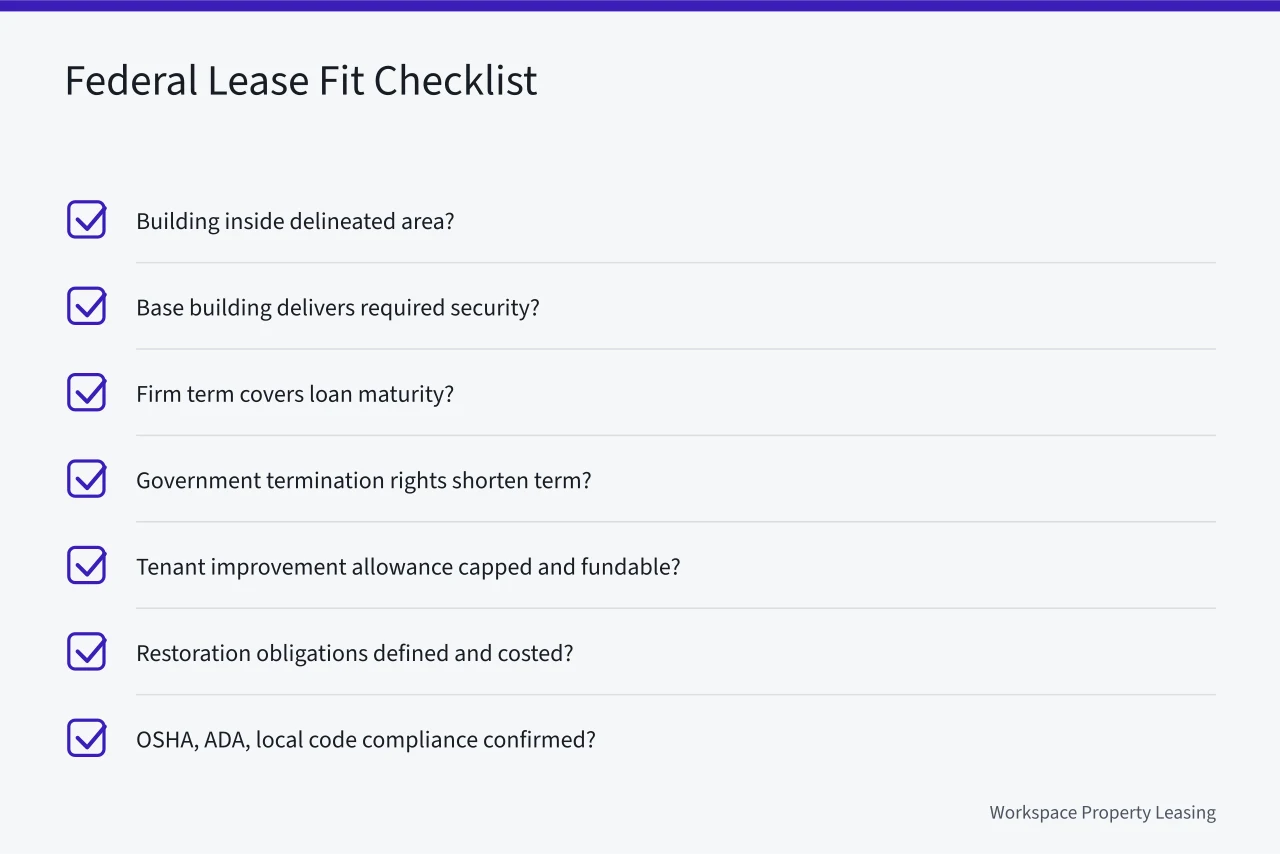
- Does the building sit inside the delineated area for the requirement?
- Can the base building deliver the required security level without a structural rebuild?
- Is the firm term long enough to cover your loan maturity with room to spare?
- Does the lease give the government termination rights that shorten your effective term?
- Is the tenant improvement allowance capped, and can you fund it?
- Are restoration obligations at expiration defined and costed?
- Have you confirmed OSHA, ADA and local code compliance for the proposed build-out?
- Has your lender confirmed it will underwrite a federal lease on these terms?
If you are weighing federal tenancy against private tenants, compare the whole package: credit strength, term certainty, build-out cost, restoration risk and administrative burden. Federal rent is reliable, but the lease is rigid, and rigidity has a price.
If you need to exit before expiration, the consent standard for subleasing office space decides how much control you keep. Federal space is not easy to backfill, so confirm that standard before you sign.
Landlords who do well with GSA are the ones who treat the solicitation as the product. Learn the requirement, price the security honestly, and keep the documents clean. The rest is repetition across markets, from a courthouse annex in Georgia to a field office in Colorado.